Spinner Wheel
Paste a list of names, options or prizes — one per line — and spin. The winner is drawn with your browser’s cryptographic random number generator, so every entry has exactly the same chance. Remove winners as you go for draws without replacement, and keep a running history of every spin.
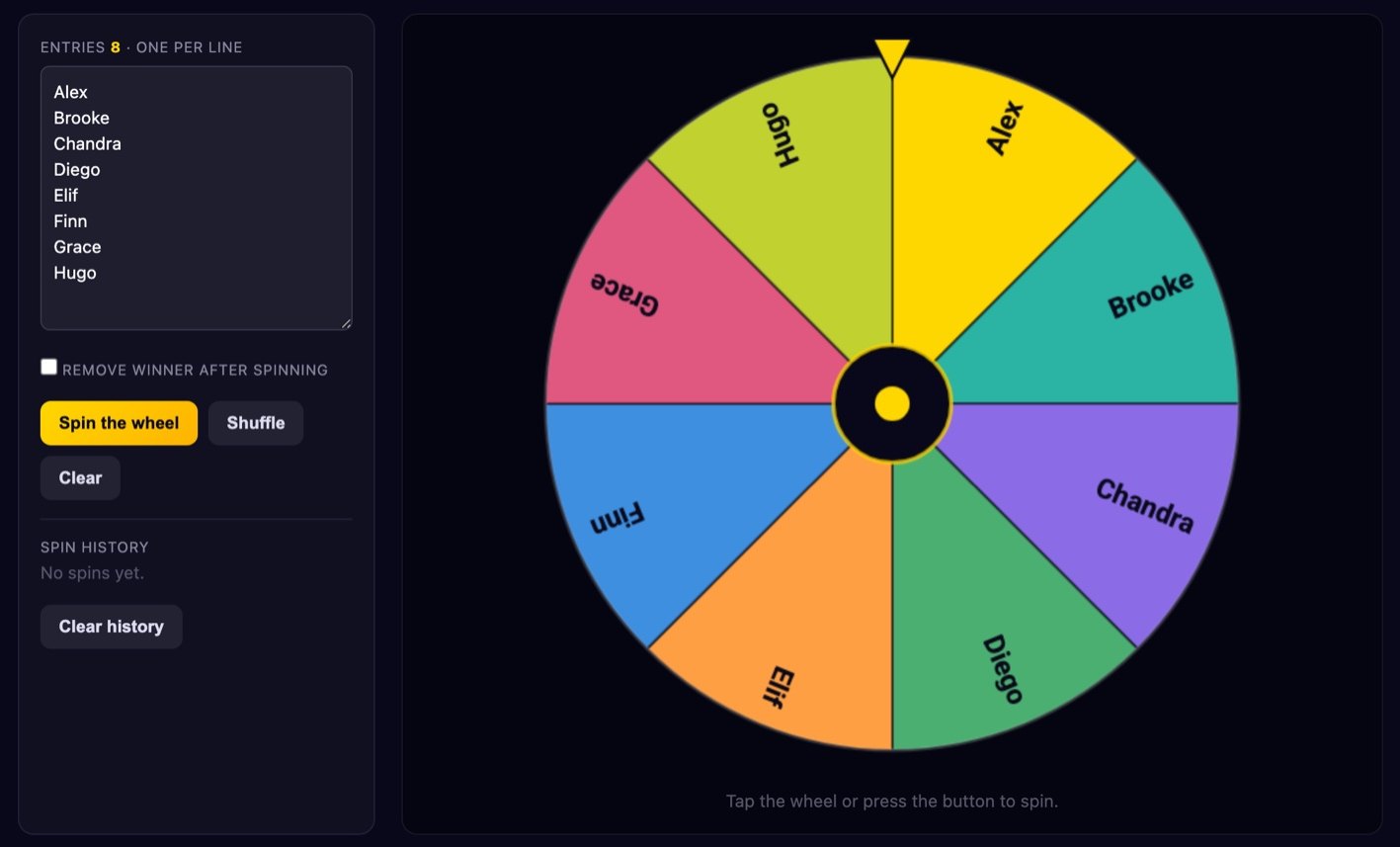
No spins yet.
Tap the wheel or press the button to spin.
How to use the spinner wheel
- Type or paste your entries. One name, option or prize per line. The wheel redraws as you type, so you can see the list take shape. Two entries is the minimum; up to 50 fit comfortably on the wheel.
- Decide whether winners stay in. Tick Remove winner after spinning if you are drawing several different winners and nobody should win twice.
- Spin. Press the button or tap the wheel itself. The wheel accelerates, slows over about four seconds and stops with the pointer at the top on the winning slice.
- Read the result. The winner appears over the wheel and is added to the history list, so you still have the full order of results after ten draws.
- Come back later. Your entry list is saved in your browser, so reloading the page or closing the tab does not cost you the list you just typed.
What people use a random wheel for
A wheel is really just a visible coin flip with more than two sides, and that visibility is the point — everyone watches the same draw happen at the same time.
- Classroom cold-calling. Paste the class list and spin to decide who answers next. It removes the awkwardness of a teacher appearing to pick on the same three students, and quieter students get called as often as the confident ones.
- Picking helpers and jobs. Who hands out the sheets, who feeds the class fish, who reads first. With remove winner switched on you can work through a whole rota in one sitting.
- Giveaway winners. Paste the entrant list from your comments or sign-up sheet and draw live. The animation is what makes it feel legitimate to an audience.
- Deciding who goes first. Board games, presentations, penalty order, who has to explain the outage to the client.
- Choosing where to eat. The classic use. Five restaurants nobody can choose between, one spin, argument over.
- Assigning chores. Put the unpleasant jobs on the wheel rather than the people, and spin once per housemate.
- Standup order. A different speaking order every morning stops the same person always going last and always running out of time.
Is the spin actually random?
Yes, and it is worth being precise about how. When you press spin, the tool first asks your browser for a random number using crypto.getRandomValues — the same cryptographically secure generator browsers use for security-sensitive work — and uses rejection sampling so that the number maps onto your entries without any bias towards the low indexes. That draw picks the winner. Only then does the animation start, and the final rotation angle is calculated backwards from the winning slice so that the pointer lands exactly on it.
In other words, the spinning is presentation. It is there so a room full of people can watch a result arrive rather than have it appear instantly, but it has no influence at all on who wins. Nothing about your mouse movement, the spin duration or how hard you tap changes the outcome, and the tool never picks whatever slice the animation happens to drift onto — that would let rounding decide the winner.
The other half of fairness is geometry. Every entry gets an identical slice: with ten names each slice is exactly 36 degrees. A wheel with visibly unequal segments would be unfair by construction, because a bigger slice is a bigger target, and anyone watching would rightly question the result. If you ever see a wheel where one option has a noticeably wider wedge, treat the draw with suspicion. Weighting entries is a legitimate thing to want — some raffles sell multiple tickets per person — but the honest way to do it here is to add that person’s name to the list more than once, so the extra chances are visible on the wheel instead of hidden in the code.
Drawing with or without replacement
“With replacement” means the winner stays on the wheel and can win again. “Without replacement” means they are removed after winning. The checkbox switches between the two, and picking the wrong one is the most common way a draw goes wrong.
Remove the winner when the results have to be distinct. Multi-prize giveaways where one person should not take first, second and third. Seating or speaking order, where you spin repeatedly until the list is empty and the order of winners becomes the running order. Assigning five different chores to five different people. Splitting a group into pairs.
Keep the winner in when every spin is an independent question. Classroom cold-calling during a single lesson, where the same student genuinely might be asked twice and being “safe” after one answer encourages people to switch off. Choosing a restaurant this week when last week’s choice is still a perfectly good option. Any situation where you want each spin to be a fresh, unbiased shot at the same set of options.
One subtlety worth knowing: with replacement, repeats are more likely than intuition suggests. With 23 spins over 365 options you are already more likely than not to see a duplicate. If duplicates would be embarrassing, remove the winner rather than hoping.
Running a fair giveaway
The mechanics of a fair draw matter less than being able to show that it was fair. A few habits make that straightforward:
- Fix the entry list before you spin. Export or screenshot the final list of entrants, in order, before the wheel ever turns. A list that changes mid-draw is impossible to audit afterwards.
- Screen-record the draw. One continuous recording that shows the full list, then the spin, then the result, answers almost every complaint before it is made. Cutting between the list and the winner does not.
- Announce the rules in advance. How to enter, when entries close, how many winners, how you will contact them, what happens if a winner does not reply within a stated window, and whether you will redraw.
- Say what happens to duplicates. If one person entered five times, decide beforehand whether that is five chances or one, and state it.
- Check the platform’s promotion rules. Instagram, TikTok, YouTube, Facebook and X each publish their own promotion guidelines, and they change. Most require you to state that the platform is not affiliated with or sponsoring the giveaway, and several forbid asking people to tag inaccurate accounts or to repost to their own feed as a condition of entry. Local law may also require published terms, an age limit or a named promoter — prize draws are regulated in many countries.
- Keep a draw record. The history list on this page gives you the order of winners for the session; save it with your recording.
Is my list uploaded?
No. The wheel is drawn with the HTML5 Canvas API and the draw happens in JavaScript on your own device. Your entries are never sent to us or to anyone else — there is no server call involved in spinning. The only place your list is stored is your own browser’s local storage, under the key twittyn_wheel_entries, purely so the list survives a reload. Press Clear or clear your browser’s site data to remove it. Details in our Privacy Policy.
Frequently asked questions
How many entries can the wheel handle?
Two at minimum and about 50 in practice. Beyond roughly 30 the slices get narrow and labels are shortened to fit, so if you have hundreds of names a random number or a list shuffle is easier to read than a wheel.
Why is my long name cut short on the wheel?
Labels are truncated so they stay inside their slice — the more entries you add, the fewer characters fit. The full text is always used for the winner announcement and the history list, so nothing is lost.
Can I make one entry more likely to win?
Add it to the list several times. Three lines with the same name means three slices and three times the chance, and anyone watching can count the slices and verify it.
Does the wheel work offline or on a phone?
Once the page has loaded there is nothing left to fetch, so it keeps working offline. On a phone or tablet you can tap the wheel itself to spin instead of using the button.
Can I get the same result twice on purpose?
No, and that is deliberate. There is no seed to enter and no way to pre-set the outcome, which is exactly what makes the result trustworthy when someone else is watching.
More tools: settle a smaller question with the dice roller, split a group into balanced sides with the team picker, or browse everything in twittyn tools.