Dice Roller
Roll any dice you need — d4, d6, d8, d10, d12, d20 or d100 — or just type standard notation like 2d6+3 and hit roll. You get every individual die, the modifier and the total, plus a history of your last rolls. Numbers come from your browser’s cryptographic random generator, so every face is genuinely equally likely.
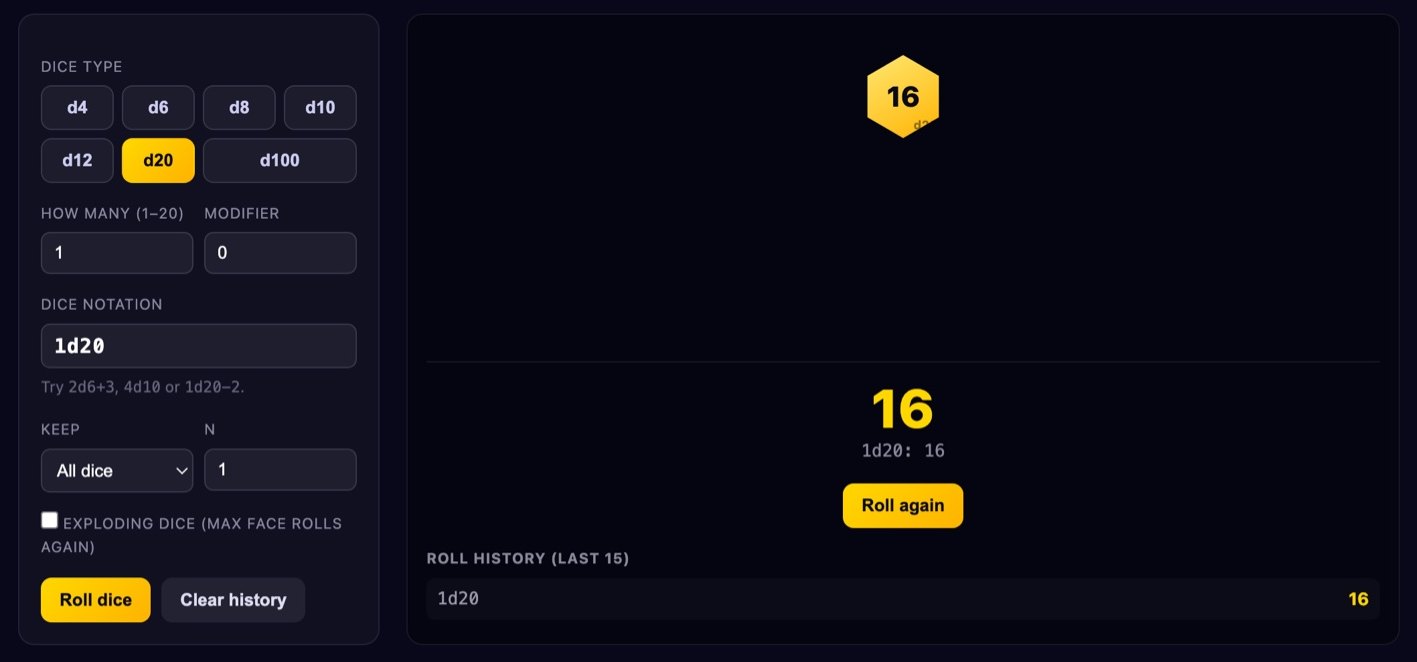
2d6+3, 4d10 or 1d20-2.Roll history (last 15)
- no rolls yet—
How to roll dice
- Pick a die. Tap d4, d6, d8, d10, d12, d20 or d100. The d20 is the workhorse of most tabletop RPGs; the d6 is what almost every board game in your cupboard uses.
- Choose how many. Set the count from 1 to 20. Rolling several dice at once is faster than rolling one repeatedly, and it is what most attack and damage rules actually ask for.
- Add a modifier. Type a positive number for a bonus (
+3) or a negative one for a penalty (-1). The modifier is applied once to the total, not to each die. - Or just type the notation. The notation box accepts the standard format directly:
2d6+3,4d10,1d20-2. You can even appendkh1orkl1to keep the highest or lowest die, e.g.2d20kh1for an advantage roll. - Roll. The dice shuffle for about half a second, then settle on their values. Each die is shown separately, dropped dice are greyed out, and the total appears underneath along with the arithmetic.
Dice notation explained
Dice notation is a compact way of writing “roll these dice and add this number”. The general form is NdX+M:
- N — how many dice you roll. If it is missing it means one, so
d20and1d20are the same thing. - d — just the separator, short for “dice”.
- X — how many faces each die has. A d10 produces 1 to 10; a d100 produces 1 to 100.
- M — a flat modifier added to (or subtracted from) the total after all the dice are summed.
Worked examples. 2d6+3 means roll two six-sided dice, add them together, then add 3: the possible totals run from 5 to 15. 4d10 means roll four ten-sided dice and sum them, giving 4 to 40 with no modifier. 1d20-2 is a single twenty-sided die minus 2, so −1 to 18. And 3d8+2 — a fairly typical weapon damage line — gives 5 to 26.
The most common mistake is treating the modifier as per-die. In 3d6+2 you add 2 once, for a range of 5–20, not 2 to each die for 9–24. If a rule really does want the bonus on every die it will say so explicitly, usually written as 3d6 with “+2 per die” spelled out in words.
Why 2d6 is not the same as 1d12
Both produce numbers in roughly the same neighbourhood, so people assume they are interchangeable. They are not, and the difference is the single most useful thing to understand about dice.
A d12 is flat. There are twelve faces, each has exactly one way of coming up, so every value from 1 to 12 has a probability of 1 in 12, about 8.3%. A 1 is exactly as likely as a 7.
Two six-sided dice behave completely differently. There are 6 × 6 = 36 equally likely combinations, but those combinations do not spread evenly across the totals. A 2 requires both dice to show 1 — one combination out of 36. A 7 can be made six different ways (1+6, 2+5, 3+4, 4+3, 5+2, 6+1). The result is a triangular, bell-shaped distribution:
- 2 and 12 — 1 way each, 2.8%
- 3 and 11 — 2 ways, 5.6%
- 4 and 10 — 3 ways, 8.3%
- 5 and 9 — 4 ways, 11.1%
- 6 and 8 — 5 ways, 13.9%
- 7 — 6 ways, 16.7%
So 2d6 also has a lower minimum (2 rather than 1) and a different average (7 rather than 6.5), but the real point is the shape. Rolling 2d6, you land on 6, 7 or 8 about 44% of the time, and you hit an extreme (2 or 12) only about 5.6% of the time. On a d12 the extremes come up 16.7% of the time — three times as often. If a game wants dependable, predictable results it uses several small dice; if it wants wild swings it uses one big die. That is why a swingy game like classic d20 combat feels so different from a settling, average-seeking game like Catan or Ticket to Ride.
Advantage, disadvantage and keeping dice
The “keep highest / keep lowest” option covers the advantage mechanic that modern tabletop games lean on. You roll two d20s and use only the better one — notation 2d20kh1.
A single d20 averages 10.5. Rolling two and keeping the higher raises the average to about 13.83, roughly the same as a flat +3.3 bonus. Keeping the lower (disadvantage, 2d20kl1) drops it to about 7.18.
But the average understates how strong advantage feels, because its effect is not uniform. If you need a 15 or better, a single d20 succeeds 30% of the time. With advantage you fail only if both dice miss: 0.7 × 0.7 = 49%, so you succeed 51% of the time — the success rate nearly doubles. Advantage helps most when your chance was near 50% (it adds about 25 percentage points there) and helps least when you were nearly certain or nearly hopeless. It also quietly halves your chance of the dreaded natural 1, from 5% to 0.25%, which is a large part of why it feels so comfortable at the table.
The same mechanic appears elsewhere: some systems roll 4d6kh3 for ability scores — four six-sided dice, drop the lowest — which pushes the average from 10.5 up to about 12.24 and makes very low scores rare.
Are virtual dice fair?
Yes, and in practice they are fairer than physical dice. This roller uses crypto.getRandomValues(), the browser’s cryptographically secure random number generator, rather than the ordinary Math.random(). It also uses rejection sampling: instead of simply taking the remainder of a random number (which subtly favours the lower faces whenever the die size does not divide evenly into the random range), it discards values that fall outside a clean multiple of the die size and draws again. The result is exactly uniform — every face has precisely the same chance on every roll.
A real die cannot claim that. Injection-moulded dice have air bubbles, unevenly drilled pips, rounded corners of slightly different radii and mould seams, and cheap d20s in particular are measurably biased. Casinos use razor-edged, flush-pipped precision dice for exactly this reason. Your plastic d20 is fine for a game night, but it is not more “honest” than the maths here.
One thing to be clear about: the dice have no memory. Each roll is completely independent of the last. There is no compensation mechanism that owes you a 20 because you have been unlucky, and none that punishes you for a hot streak.
Is anything uploaded?
No. Every roll is generated on your own device and stays there. Nothing is sent to a server, no roll history is stored anywhere but in this page (it disappears when you close the tab), and there is no account to create. Details are in our Privacy Policy.
Frequently asked questions
Can it be rigged?
Not by us in any hidden way — the entire roller is plain JavaScript running in your browser, and you can read it with View Source. It calls the browser’s own cryptographic generator, which is the same primitive used to create encryption keys. There is no server involved that could bias a result, and no reason for us to want to.
Why did I roll three 20s in a row?
Because streaks are normal, not evidence of a fault. Three 20s in a row on a d20 has a probability of 1 in 8,000. That sounds impossible until you notice how many rolls happen: across a long campaign, or across everyone using this page in a single day, runs like that are expected to appear regularly. Rolls are independent events — the die does not know what it did last time — and truly random sequences contain far more clumping than people intuitively expect. A sequence that looked perfectly evenly spread would actually be the suspicious one.
What is the difference between d100 and percentile dice?
They give the same range. Physically, percentile dice are two d10s, one read as tens and one as units, with 00+0 counted as 100. This tool rolls a single d100 directly, which produces exactly the same uniform 1–100 result with fewer steps.
What does “exploding dice” mean?
When a die rolls its maximum face, you roll it again and add the new value, repeating as long as it keeps maxing out. A d6 that rolls 6, then 6, then 3 counts as 15. It creates a small chance of dramatic, open-ended results and is used by systems like Savage Worlds. It also raises the average: an exploding d6 averages 4.2 instead of 3.5. The toggle is off by default because most games do not use it.
How many dice can I roll at once?
Up to 20 at a time, which covers almost every rule you will meet, including large damage rolls like 10d6 for a fireball. For anything bigger, roll twice and add the totals together — the result is statistically identical.
Want more? Flip a virtual coin with our coin flip tool, pick a number from any range with the random number generator, or browse everything else in our free tools collection.