Coin Flip
Tap the coin for an honest heads or tails. Every result is drawn from your browser’s cryptographic random number generator before the coin even starts spinning, so the animation only shows you a decision that has already been made. Keep a running tally, play a best-of match, or flip a thousand times at once.
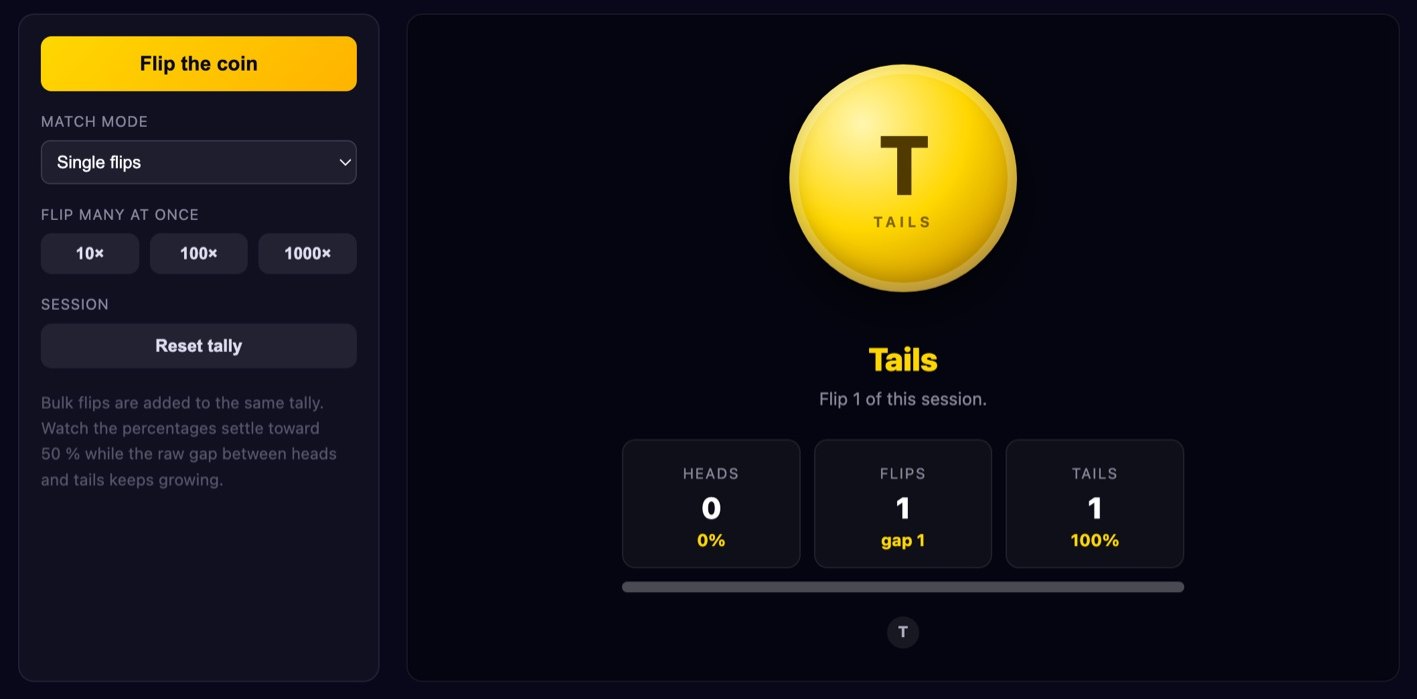
Bulk flips are added to the same tally. Watch the percentages settle toward 50 % while the raw gap between heads and tails keeps growing.
How to flip a coin online
- Flip. Click the coin itself, press the Flip the coin button, or focus the coin and hit Space or Enter. The face it lands on is the result.
- Watch the tally. Heads and tails counts, their percentages and the running gap between them update after every flip.
- Play a match. Switch to Best of 3 or Best of 5 and the tool tracks the series for you, stopping as soon as one side is mathematically ahead. The next flip starts a fresh series.
- Flip in bulk. The 10×, 100× and 1000× buttons resolve that many independent flips instantly and fold them into your session totals.
- Reset. Reset tally clears the counts and the history strip. Nothing is stored between visits.
Is a virtual coin flip really 50/50?
It is, and it is arguably fairer than the coin in your pocket. Each result here comes from crypto.getRandomValues, the browser’s cryptographically secure random number generator. It is seeded by the operating system from genuine physical entropy — interrupt timings, hardware noise sources — and it is the same generator used to create encryption keys. We read a single byte and look at its lowest bit, and because a byte has exactly 128 even and 128 odd values, heads and tails are exactly equally likely. There is no hidden weighting, no “make it feel random” smoothing, and no memory of previous flips.
Importantly, the result is decided before the animation begins. The spin is then aimed at the face that was already chosen. The animation is presentation; the randomness happened a fraction of a second earlier.
Here is the genuinely interesting part: a real coin, flipped by a real thumb, is not perfectly fair. A 2023 study led by physicist František Bartoš had 48 people flip coins 350,757 times across 46 different currencies, and found that coins land on the same side they started on about 50.8 % of the time. The effect was predicted decades earlier by Diaconis, Holmes and Montgomery, who showed that a tossed coin does not spin about a perfectly fixed axis — it precesses, wobbling like a badly thrown frisbee, and that wobble means it spends slightly more time with its starting face up. The bias is tiny per flip but it is real, and it is a bias in the starting side, not in heads or tails as such: if you do not look at which face was up before the toss, it vanishes.
Spinning a coin on a table is far worse. Because the milled edge of many coins is not perfectly symmetric, a spun coin tends to topple toward the heavier side; the classic example is that a spun US penny falls tails a large majority of the time. If you actually care about fairness, the digital version has none of these problems — and unlike a physical coin, nobody can catch it and quietly slap it onto the back of their hand.
The gambler’s fallacy
Flip five heads in a row and something in your brain insists that tails is now “due”. It is not. The coin has no memory, no ledger and no sense of fairness. The probability of tails on the sixth flip is 50 %, exactly as it was on the first. This is the gambler’s fallacy, and it is the single most expensive misunderstanding in probability — famously in 1913, when roulette at Monte Carlo landed black 26 times in a row and players lost fortunes betting ever larger sums on red.
The confusion comes from mixing up two different questions. The chance of getting six heads in a row from the start is 1 in 64, which is genuinely unusual. But you are not at the start — you are five flips in, those flips already happened, and the only question left is a single fresh flip. What people mistake for a “law of averages” that pulls results back is really just dilution: an early run of heads is not cancelled out by later tails, it is simply drowned out by a growing pile of ordinary flips.
And streaks are much more common than intuition allows. In 100 flips you should expect a run of six or seven of the same face somewhere in there; a sequence with no long runs at all would be the suspicious one. When people are asked to write down a fake random sequence, they alternate far too much, and that tell is exactly how statisticians spot fabricated data. Use the 100× button above and read the history strip — the clusters you see are not a glitch, they are what real randomness looks like.
What to expect from 10, 100 and 1000 flips
The law of large numbers says the proportion of heads converges toward 50 % as flips accumulate. It does not say the counts even out. Those are different claims, and the difference surprises almost everyone.
- 10 flips: a 6–4 split is completely ordinary, 7–3 is common, and an exact 5–5 happens only about 25 % of the time. Typical spread is roughly ±16 percentage points.
- 100 flips: most sessions land between 40 and 60 heads. Anything outside 37–63 starts to look genuinely unusual.
- 1000 flips: you will usually be within about 3 points of 50 %, so roughly 470–530 heads — but the absolute gap between heads and tails will often be 20 or 30 flips, larger in raw terms than anything you saw in the 10-flip run.
That is the whole trick: the expected gap grows roughly with the square root of the number of flips, while the number of flips grows much faster, so the gap divided by the total shrinks. Ten thousand flips might leave you 60 heads ahead in absolute terms and still sit at 50.3 %. Hit 1000× a few times above and watch the percentage tighten toward 50 while the “gap” figure in the middle card wanders further from zero.
Using a coin flip to decide
The most useful thing about a coin toss has nothing to do with probability. Flip it for a real decision and pay attention to the half second while it is in the air: you will usually notice you are quietly hoping for one particular result. That flicker of preference is the answer, and the coin was only ever a device for surfacing it. If the result lands the other way and you immediately think “best of three?”, you have learned what you actually wanted.
There is evidence this works even when you follow the coin. Economist Steven Levitt ran an experiment in which thousands of people let a coin settle a genuine life decision — quitting a job, ending a relationship — and those told to make the change reported being measurably happier six months later. People are systematically too cautious about big changes. A coin is a cheap way to break a deadlock you have already spent too long in.
Practical uses that are worth the tap: settling who goes first in a board game, splitting a chore, choosing between two restaurants nobody objects to, breaking a two-way tie in a group, or randomising the order of a task list. If a decision genuinely matters and you have real information, use the information — but for choices that are close to a tie, the deliberation itself often costs more than either outcome.
Is anything uploaded?
No. Every flip is generated locally by your own browser and never leaves your device. There is no server call, no account, no logging of results, and nothing is saved between visits — reload the page and the tally starts at zero. Details are in our Privacy Policy.
Frequently asked questions
Can I trust this more than a real coin?
For fairness, yes. A physical flip carries a small same-side bias and a spun coin can be badly skewed by its edge. The generator here is exactly balanced by construction, with no dependence on how it was launched or caught.
Are the results predictable if someone knows the code?
No. crypto.getRandomValues is designed so that seeing previous outputs gives you no useful information about the next one — that is the whole point of a cryptographic generator, and it is why the same function is used to generate keys and session tokens. This is very different from Math.random(), which is fast but not designed to resist prediction.
Why did I get eight heads in a row?
Because that happens. A specific run of eight has probability 1 in 256, but across a long session there are many places such a run could begin, so seeing one is unremarkable. Streaks are a feature of randomness, not a sign of a broken coin.
Does best-of-3 make the outcome fairer?
It does not change either side’s chance of winning — both are still at 50 % — but it reduces variance, so the winner is less likely to feel like a fluke. It also takes longer, which is sometimes exactly what you want when two people are arguing.
Can I flip more than 1000 times?
Press 1000× repeatedly; each batch is added to the running totals, so you can build a session of tens of thousands of flips and watch the percentages lock in around 50 %.
More tools
Need more than two outcomes? Roll with the dice roller, pick from a custom list with the spinner wheel, or browse everything in twittyn tools.