Case Converter
Paste text and switch it to UPPERCASE, lowercase, Sentence case or a proper Title Case that keeps small words like “of” and “the” lowercase. Programmer formats — camelCase, PascalCase, snake_case, kebab-case and CONSTANT_CASE — are one click away too. Everything runs in your browser.
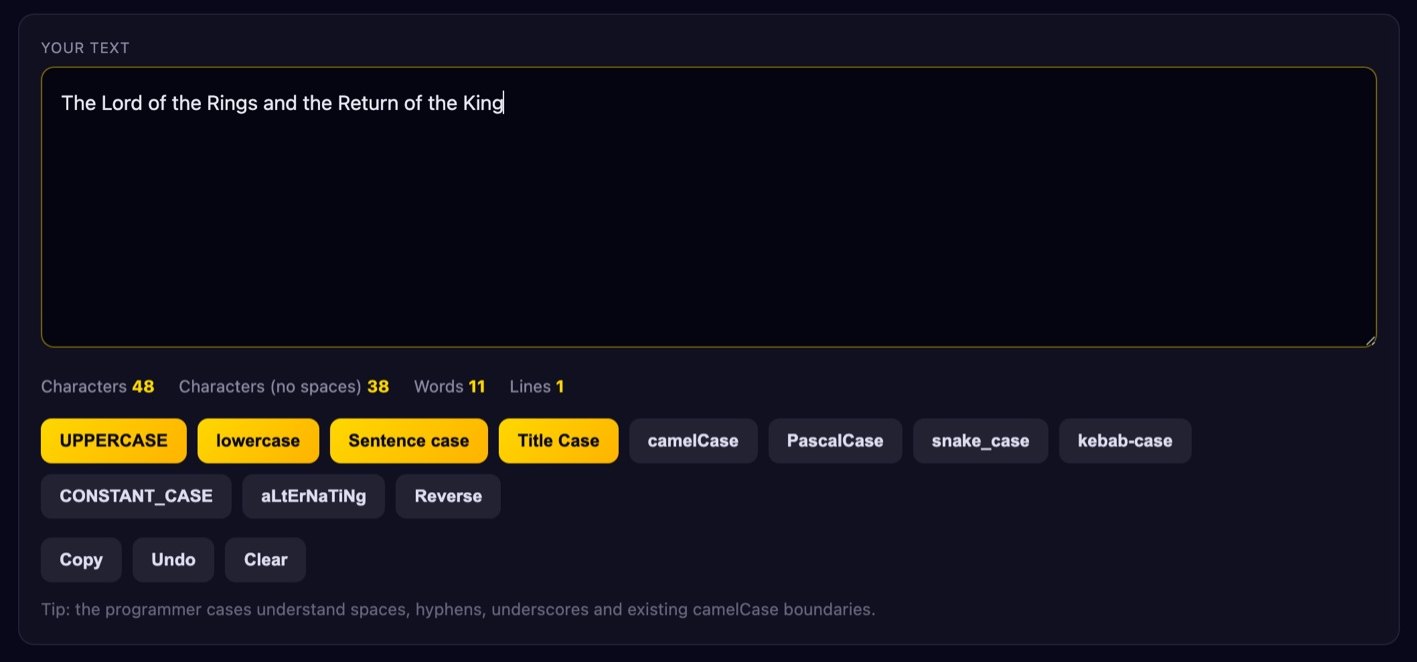
Tip: the programmer cases understand spaces, hyphens, underscores and existing camelCase boundaries.
How to convert text case
- Paste your text. Drop it into the box above — a word, a headline, a whole article or a column exported from a spreadsheet. There is no length limit beyond what your browser can hold in memory.
- Pick a case. Each button rewrites the text in the box immediately, so you can chain conversions: send a messy ALL CAPS heading to lowercase first, then to Title Case for a clean result.
- Check the counts. Characters, characters without spaces, words and lines update live, which is handy when you are writing to a limit — a 60-character page title, a 155-character meta description, a 280-character post.
- Copy or undo. Copy puts the result on your clipboard and confirms it. Undo steps back through your last few conversions if a click did not do what you expected, and Clear empties the box.
Title case vs sentence case
Sentence case is the simple one: you capitalise the first letter of the sentence and any proper nouns, and everything else stays lowercase. How to convert text case in your browser. Title case capitalises most of the words in the line: How to Convert Text Case in Your Browser.
The interesting part is deciding which words stay small, and this is exactly where style guides disagree. AP style uses a length rule: capitalise every word of four letters or more, so With, From and Into get capitals while of, in and the do not. Chicago style uses a part-of-speech rule instead: capitalise nouns, pronouns, verbs, adjectives and adverbs regardless of length, and lowercase articles, coordinating conjunctions and prepositions no matter how long they are — which is why Chicago writes Notes on the State of Virginia but also keeps a long preposition like throughout lowercase. APA sits in between, capitalising words of four letters or more much like AP.
All of them agree on two things: the first word of the title is always capitalised, and so is the last one, even if it is a tiny preposition. What Are You Waiting For ends with a capital For. This converter follows that shared core — short articles, conjunctions and prepositions (a, an, the, and, but, or, nor, for, of, in, on, at, to, by, vs and friends) drop to lowercase unless they open or close the line, or follow a colon.
Which should you use? For product interfaces, documentation and most web writing, sentence case has quietly become the default. Google, Apple, Microsoft and Shopify all specify it in their design systems. It reads faster, it is far easier to apply consistently across a large team, it survives translation better (German, French and Spanish do not title-case headings at all), and it makes genuine proper nouns stand out instead of disappearing into a wall of capitals. Title case still belongs in editorial headlines, book and article titles, and anywhere a house style demands it — but if you are naming a button, a settings row or a page heading in an app, sentence case is the safer choice.
camelCase, snake_case, kebab-case — when each is used
Programming languages do not care about capitalisation, but their communities care a great deal, and using the wrong convention is the fastest way to make code look foreign. The conventions break down roughly like this:
- camelCase — variables, function names and object properties in JavaScript, TypeScript, Java, C# (for locals and parameters), Swift and Kotlin.
userName,getTotalPrice. JSON payloads from JavaScript back ends are usually camelCase too. - PascalCase (also called UpperCamelCase) — class names, types, interfaces and enums almost everywhere, plus React and Vue component names.
UserProfile,PaymentGateway. React actually requires it: JSX treats a lowercase tag as an HTML element, so<userCard />silently renders nothing useful. - snake_case — Python variables and functions (PEP 8 mandates it), Ruby, Rust variables and functions, and database work: PostgreSQL and MySQL column and table names are conventionally snake_case because unquoted identifiers get folded to lowercase anyway.
created_at,total_amount. - kebab-case — anything that lives in a URL or in markup. URL slugs (
/tools/case-converter), CSS class names (.nav-links), custom HTML attributes (data-cookie-settings), custom element names, npm package names and most command-line flags. It is the right choice here because hyphens are legal and readable in URLs while underscores can vanish under a link underline. - CONSTANT_CASE (SCREAMING_SNAKE_CASE) — environment variables (
DATABASE_URL,API_KEY), compile-time constants in C and C++ macros, and module-level constants in Python and JavaScript. The shouting is the point: it flags a value that should never change at runtime.
The tricky part when converting is splitting the input, not joining it. This tool splits on spaces, hyphens, underscores, dots and slashes and on internal capital letters, so getHTTPResponse, get-http-response and Get HTTP Response all reduce to the same three words before being rejoined in whatever style you asked for. Sequences of capitals are handled as one unit so acronyms do not shatter into single letters.
Why ALL CAPS hurts readability
Fluent readers do not decode words letter by letter; they use the overall shape of a word — the pattern of ascenders like b, d and k, descenders like p, g and y, and the x-height body in between — as a first-pass cue before confirming the letters. Set a word in capitals and every letter becomes the same rectangular height, so that cue disappears and reading slows measurably, especially across long lines. Capitals also take more horizontal space, which means more line breaks and more eye movement for the same content.
There is a social cost as well. Since the earliest days of email and bulletin boards, capitals have signalled shouting, and that reading is now firmly established in chat, comments and support tickets. A message written in caps reads as angry even when it was only meant to be emphatic.
None of this makes uppercase useless — it is excellent for short labels where you want a visual block rather than a readable word: button text, table headers, small navigation labels, logo type, warning tags. The rule of thumb is a few words at most, and never a whole sentence or paragraph. If you need emphasis inside running text, bold or italics will do the job without costing your reader speed. And if you inherit a document that is already shouting, convert it to lowercase first and then to Sentence case rather than trying to fix it by hand.
Is my text uploaded?
No. Every conversion on this page is plain JavaScript running on your own device — there is no server call, no logging and no storage. Nothing you type is transmitted anywhere, which makes it safe for drafts, client copy, internal names and anything else you would not paste into a random website. You can confirm it by opening your browser's network tab, or by loading the page and then going offline: the tool keeps working. Details are in our Privacy Policy.
FAQ
Does it handle accented and non-English characters?
Yes. Conversions use toLocaleUpperCase and toLocaleLowerCase, so accented Latin letters, German umlauts, Greek and Cyrillic convert correctly, and ß expands to SS in uppercase as it should. Locale-specific rules such as Turkish dotted and dotless i follow your browser's language setting.
Why did Title Case leave some words lowercase?
That is deliberate. Short articles, conjunctions and prepositions stay lowercase in the middle of a title under every major style guide. They are still capitalised when they are the first or last word, or when they follow a colon. If your house style capitalises everything, use Title Case and then fix the few words by hand, or ask us for an AP-strict mode.
Will it wreck acronyms like NASA or HTML?
Title Case and Sentence case leave existing all-caps words of two or more letters alone, so NASA and HTML survive. The programmer cases treat a run of capitals as a single word, so parseHTMLDocument becomes parse_html_document rather than parse_h_t_m_l_document.
What does Sentence case do with the word “I”?
It keeps it capitalised. The standalone English pronoun I, plus contractions like I'm, I'll and I've, are preserved even though everything else after the first letter is lowercased. New sentences are detected after a full stop, exclamation mark or question mark, and after line breaks.
Can I undo a conversion?
Yes — Undo steps back through the last twenty states, including your own typing between conversions. Your browser's own undo shortcut also works inside the text box.
More text tools: count words and reading time with the word counter, turn a picture into text with the ASCII art generator, or browse everything in tools.