Plinko Reveal
Drop a stream of balls through a field of staggered pegs and watch your photo emerge one tile at a time, the way a Plinko board pays out — unpredictable, bouncy, and weirdly hypnotic to watch.
▶ Play Plinko Reveal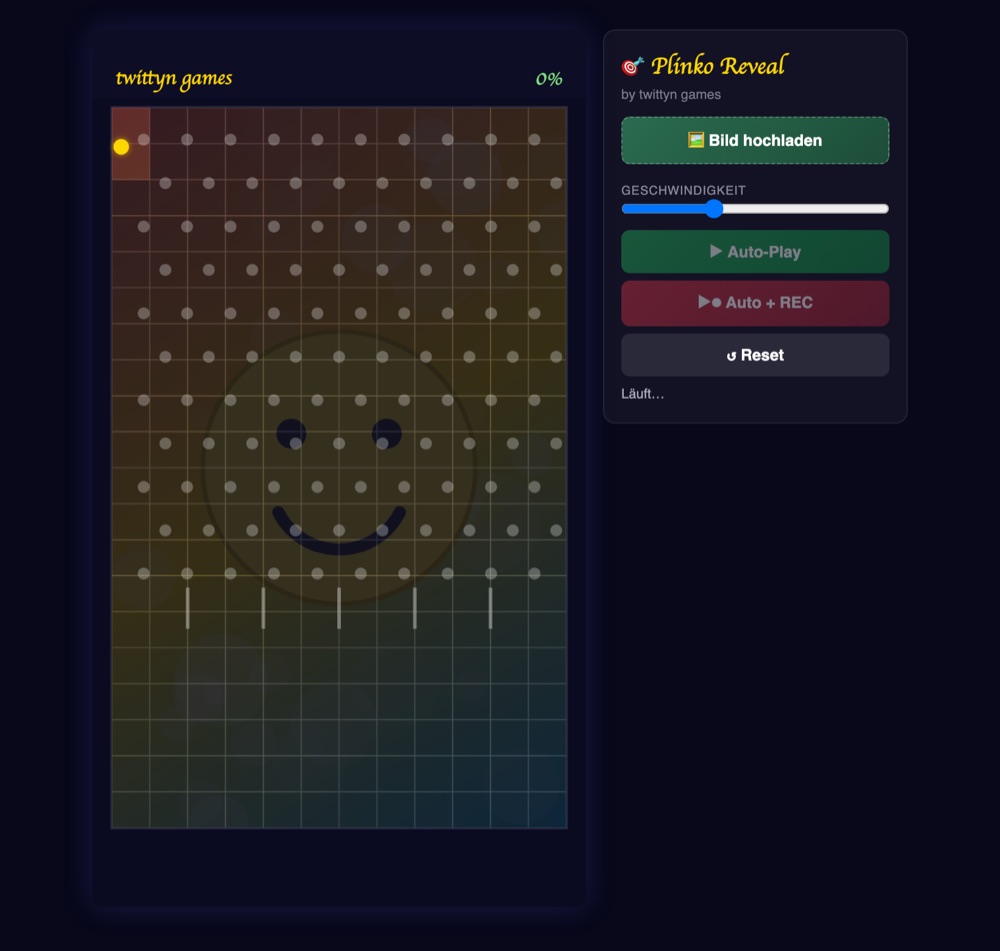
Under the hood: gravity, pegs, and a bit of jitter
We built Plinko Reveal on real physics rather than a canned drop animation. Behind the tile grid sits a lattice of pegs spaced 95px apart in the classic staggered pattern — every other row shifts sideways by half that spacing, so a ball almost never gets a clean, straight run to the bottom. The peg field fills the upper two-thirds of the board; the bottom third is reserved for six buckets and their divider walls. Balls fall under a constant gravity of 2200 pixels per second squared and start with a small sideways nudge rather than dropping dead straight, so the same release point rarely produces the same path twice.
Each peg strike applies a restitution of 0.55 — a 17px ball keeps a little over half its incoming speed along the bounce normal when it clips a 13px peg — plus a small random jitter on top of the physics-correct bounce, up to ±40 sideways and ±20 vertical. That jitter is deliberate: a perfectly centered hit would otherwise send every ball down a mathematically identical path, which reads as robotic fast. Pegs also flash white on impact and cool back down over about three tenths of a second, so you can see exactly where the last few balls have been. The whole simulation steps in 120 fixed increments per second no matter how high you push the speed slider, so nothing skips through a peg even at double speed, and the side walls dampen a bounce to 60% of incoming speed so a ball can't get stuck hugging an edge for the rest of the clip.
Why one touch isn't enough
Every tile behind the pegs tracks its own reveal value from 0 to 1, and a single pass doesn't finish the job. Each time a ball's center crosses into a new cell, that tile gains about 0.22 toward fully revealed — so it takes roughly five separate touches, not one lucky drop, before a tile is completely uncovered. That's why the picture builds up in soft layers instead of snapping into place: one ball crossing the board fades a streak of tiles partway, and it takes several more balls tracing similar paths through that same stretch to finish clearing it.
Where the bot chooses to drop
The bot isn't aiming at buckets. The six buckets at the bottom are mostly cosmetic here — each one is separated by a short 90px divider wall, and landing in any of them just triggers a small particle pop, with zero effect on what gets revealed. What the bot actually decides is where along the top edge to release the next ball. About 60% of the time it scans all 12 columns, picks whichever one still has the most unrevealed tiles, and drops there with roughly ±160px of scatter so it isn't robotically precise; the rest of the time it just picks a random x position across the play width. From the moment of release, gravity and the peg field take over completely — the same starting point can land three columns to either side by the time a ball reaches the buckets.
Up to 8 balls can be falling at once, spawning roughly every 1.5 to 2.2 seconds depending on the speed slider, which runs from 50% to 200%. If a ball ever stalls against a peg or a divider wall — its speed dropping and staying low for a full 1.5 seconds — it gets an unstick kick straight down plus a random sideways push, so nothing sits frozen mid-board for the rest of the run.
The finishing cascade
Once overall progress passes 90%, the board stops leaving the ending to chance. Every 2 seconds it finds the column with the most tiles still hidden and force-reveals it from top to bottom, staggered 60 milliseconds per tile, so the last stretch resolves as a quick visible sweep instead of the bot spending twenty seconds hunting down three stray tiles scattered across the grid. It's as much a pacing choice as a technical one — the interesting part of a Plinko run is the middle, watching the field thin out, not one stubborn corner tile refusing to clear.
Good to know: Recording happens entirely in your browser using the Canvas captureStream API. Your image and video stay on your device unless you explicitly connect a social account and press share. See our Privacy Policy for the details.
Quick facts
- The grid behind the pegs is 12 columns by 20 rows — 240 tiles in total, each needing multiple touches to clear.
- No install and no account required. JPG, PNG and WebP images all work and are scaled to fit the board automatically, or skip upload and a demo image loads instead.
- A finished run bursts about 160 confetti pieces from the center of the screen, and recording auto-stops two seconds later.
- Free to play, free to record, and you can connect TikTok from the page to share the clip directly with caption, hashtags and privacy level set before it goes out.