2048
The addictive sliding-number puzzle, rebuilt for the browser. Push every tile in one direction, merge matching numbers, and keep doubling until the 2048 tile appears — then see how much higher you can climb.
▶ Play 2048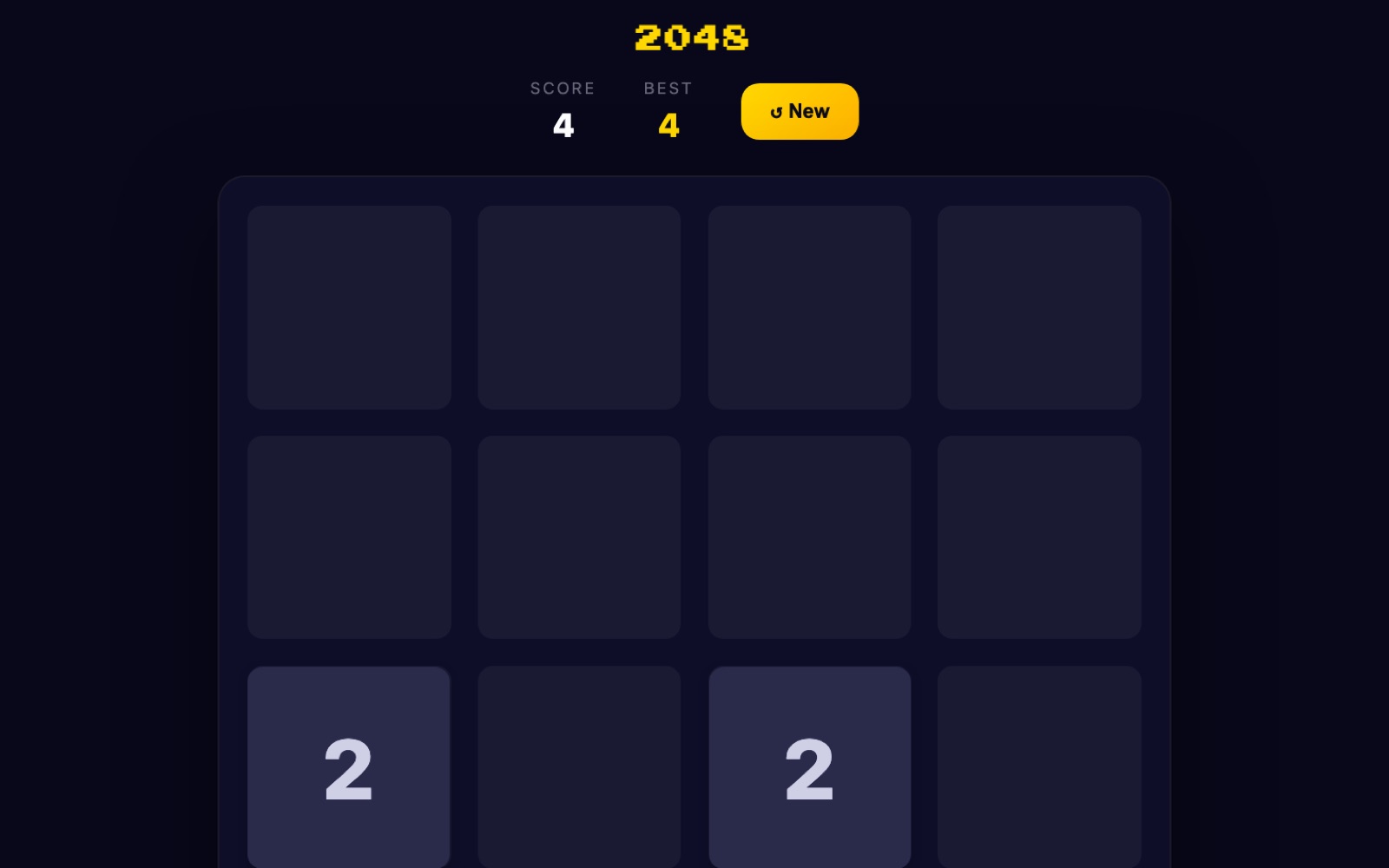
What is 2048?
2048 is a single-player number puzzle played on a 4×4 grid — sixteen cells in total. Every move slides all of your tiles as far as they can go in one direction, and any two tiles carrying the same number that bump into each other fuse into a single tile worth double. Two 2s become a 4, two 4s become an 8, and so on up the chain: 16, 32, 64, all the way to the golden 2048 tile that gives the game its name.
This version is a faithful, hand-built rebuild rather than a third-party embed. It runs on a DOM grid where each tile is positioned by percentage, so the board scales cleanly on any screen without ever needing to redraw itself. Unlike the reveal-style titles on twittyn, which are built for a bot to play in front of a camera, 2048 has no auto-play and nothing records — it is just you, four directions, and a board that fills up a little more with every move you make.
How to play
- Start with two tiles. Every new game seeds the board with two starting tiles, then adds one more after each successful move. You never place tiles yourself — you only choose which way everything slides.
- Slide with the keyboard. Use the arrow keys or W/A/S/D. One key press pushes every tile on the board as far as it can travel in that direction, all at once. Left, right, up and down are your only four inputs.
- Swipe on mobile. On a touch screen, swipe across the board in the direction you want everything to move. A swipe shorter than about 24 pixels is treated as an accidental tap and ignored, so make each gesture a clear, committed flick.
- Merge matching numbers. When two tiles of equal value collide during a slide, they merge into one tile worth their combined total, and that total is added to your score. Merge two 64s and you gain 128 points along with the new 128 tile.
- Only one merge per tile, per move. A tile that has just merged is locked for the rest of that move. Four 2s in a row become two 4s in a single slide — not a single 8 — because each freshly made tile refuses to merge again until your next move.
- Watch the new tile appear. After every move that actually changes the board, one new tile pops into a random empty cell. It is a 2 roughly nine times out of ten and a 4 the rest of the time. A move that shifts nothing at all spawns no tile and effectively passes.
- Reach 2048, then decide. The moment any tile hits 2048 you have officially won, and an overlay lets you stop or press “Keep going” to chase 4096, 8192 and beyond. The run only truly ends when the board is completely full and no neighbouring tiles share a value.
Strategy: tips for a higher score
2048 rewards planning over speed. There is no clock, so the difference between a run that stalls at 512 and one that breaks 2048 is almost entirely about how you organise the board.
- Pick a corner and keep your biggest tile there. The single most important habit is anchoring your largest number in one corner — say the bottom-right — and never letting it drift. Favour two directions (for a bottom-right anchor, that is down and right) and avoid the opposite ones unless you have no choice. A big tile that wanders into the middle blocks merges from every side.
- Build a descending chain, or “snake”. Line your values up in order along a row or in an S-shape: the biggest in the corner, then the next-biggest beside it, and so on. When the whole chain shares an edge, a single well-timed slide can cascade several merges at once, since each merged tile becomes the new partner for the one behind it.
- Don't chase every small merge. Clearing 2s and 4s the instant they appear feels productive but scatters your board. It is usually better to let a couple of small tiles sit while you keep the big ones aligned. Merging up the value ladder is what grows your score — the score is the sum of every merged total, so one 512 merge is worth far more than dozens of 4s.
- Protect your open cells. A new tile spawns after every real move, so the fuller the board, the closer you are to losing. Keeping several empty cells in reserve gives you room to manoeuvre when an awkward 4 lands in the wrong spot.
- Avoid the panic up-move. If your anchor is at the bottom, pushing up sends your largest tiles into the top row and often strands them away from their merge partners. Treat the “forbidden” direction as an emergency-only key, and think one move ahead before you press it.
Good to know: Your best score is saved locally in your browser under a single small key, so it is still there next time you visit — no login required. It updates the instant a run beats your previous record, and clearing your browser data is the only thing that resets it. See our Privacy Policy for details.
Frequently asked questions
How do I win at 2048?
You win the moment any single tile reaches the value 2048. When that happens a “You made 2048!” overlay appears, and you can either stop there or tap “Keep going” to keep merging toward 4096 and higher for a bigger score.
When does the game end?
The game is over only when the board is completely full and no two neighbouring tiles share the same number, meaning no legal move remains. As long as one empty cell exists or any adjacent pair matches, you can keep playing.
Is a new tile always a 2?
No. Each new tile is a 2 about 90% of the time and a 4 the other 10%. The value is random each move, and the tile always lands in a randomly chosen empty cell.
Why didn't anything happen when I pressed a key?
If nothing can slide or merge in the direction you chose, the board doesn't change and no new tile is added — the move is simply ignored. This usually means every tile is already pushed as far as it can go that way.
Can I play on my phone?
Yes. Swipe in any of the four directions to slide the tiles. There is nothing to install; 2048 runs entirely in your browser on desktop or mobile.
Is it free?
Yes, 2048 is completely free to play, with no time limits, no accounts and no paywalls.