Sliding Puzzle
The classic 15-puzzle, rebuilt for the browser. Slide the numbered tiles around a 4×4 grid until they run 1 to 15 in order, with the empty space back in the bottom-right corner. No download, no account, no bot — just you and the tiles.
▶ Play Sliding Puzzle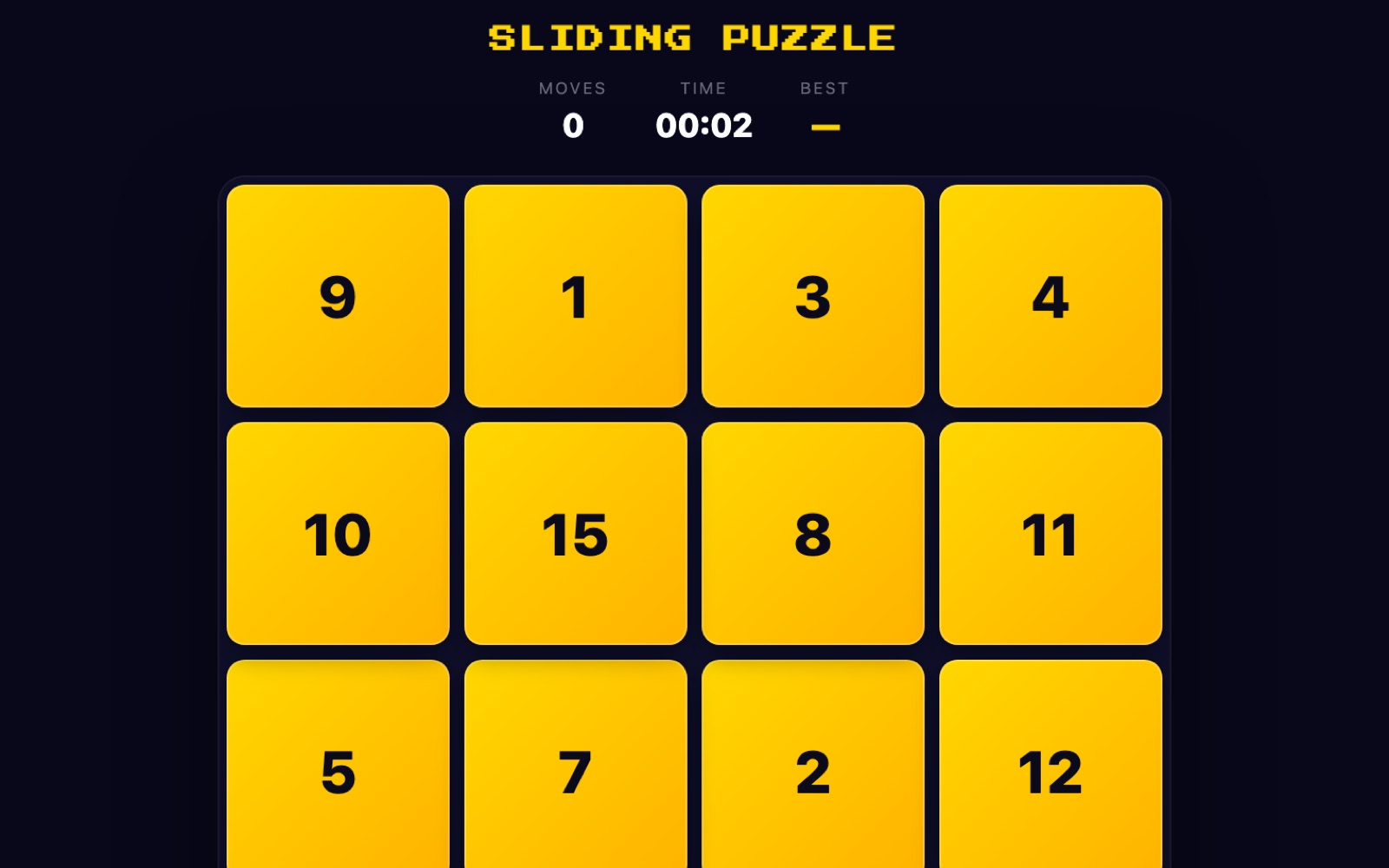
What is the sliding puzzle?
The sliding puzzle — often called the 15-puzzle — is a 4×4 grid holding fifteen numbered tiles and one empty space. Because one square is always blank, any tile next to that gap can slide into it, and nothing ever lifts off the board. The goal is simple to state and stubborn to reach: arrange the tiles so they read 1, 2, 3, 4 across the top row, then 5 through 8, then 9 through 12, then 13, 14, 15 along the bottom — with the blank resting in the bottom-right corner where it started.
It's a puzzle of order and constraint. You can never pick a tile up and drop it where you want; every move is a slide into the one open square, so getting a late tile into place often means carefully disturbing tiles you already solved and putting them back. That tension — between the piece you're placing and the pieces you're protecting — is the whole game. This version tracks your moves and your time, and saves your fewest-moves solve as your best, so there's always a number to chase.
How to play
- Shuffle and start. Press “Shuffle & Start” on the board (or hit Space/Enter). The tiles scramble from the solved layout and the timer begins.
- Click or tap a tile to slide it. Any tile that shares a row or column with the blank can move. Click it and it slides toward the gap — and here's the useful part: if there are other tiles between it and the blank, they all slide along too, in a single move. Tap the far end of a row and the whole run shifts over at once.
- Or steer with the arrow keys. On desktop, an arrow key pulls the neighbouring tile into the blank — a single-tile step. Think of it as moving the gap: pressing Left slides the tile on the blank's right into it, Up pulls the tile below up, and so on.
- Watch your counters. Every slide — whether it moved one tile or four — counts as one move. The MOVES and TIME readouts update live at the top.
- Finish in order. The puzzle is solved the instant the tiles read 1 through 15 with the blank bottom-right. A “Solved!” panel shows your moves and time, and flags a new best if you beat it.
- Play again. Hit “New Game” any time for a fresh shuffle. The board reshuffles from solved, so every game is a different scramble.
How to solve it (a reliable method)
Random slides eventually get you there, but a layered method gets you there every time and with far fewer moves. The idea is to lock the puzzle down piece by piece, shrinking the part you still have to worry about until only a tiny corner is left. Work in this order and never disturb what you've already finished.
1. Solve the top row (1, 2, 3, 4)
Place 1 in the top-left, then 2 beside it, then 3. Tile 4 — the top-right corner — is the tricky one: don't try to force it straight in. Instead, park 4 directly below its home square and put 3 in the top-right corner temporarily, then rotate the pair into place (slide 4 up, then 3 across). This corner trick is what stops you from wrecking 1, 2 and 3 while you seat the last tile of the row.
2. Solve the left column (5, 9, 13)
With the top row locked, turn the board on its side in your head and do the same to the first column. Set 5, then 9, then 13 — and 13, the bottom-left corner, gets the same rotation trick 4 did: stage it and its neighbour, then rotate them home so you never touch the finished top row.
3. Reduce to a 3×3, then a 2×2
Now the top row and left column are done for good, and everything worth solving sits in the bottom-right 3×3 block. Solve its top row and left column the same way — place 6, 7 with the corner trick, then 10 — and you're left with a 2×2 square: tiles 11, 12, 14, 15 and the blank.
4. Rotate the final corner
A 2×2 corner can only be cycled — the three tiles just rotate around the blank. Spin them clockwise or anticlockwise until they click into order. If they seem to rotate forever without landing, it's almost always because a tile from an earlier stage slipped — recheck the row and column above before assuming the corner is stuck.
Why every shuffle can be solved
Here's a fact that trips people up: of all the ways you could arrange fifteen tiles, exactly half are impossible to solve by sliding. Swap just two tiles on a finished board and no sequence of slides will ever fix it — the puzzle is mathematically locked out. That's why a truly random arrangement is a coin-flip on whether it's even solvable. This game sidesteps the problem entirely: it doesn't drop tiles into random spots. It starts from the solved board and plays a long string of legal slides — around 150 to 190 of them — to scramble it. Since every move it makes is one you could undo, the finished scramble is always reachable and therefore always solvable. You'll never be handed an impossible board.
Chasing your best: Your best score here is the fewest moves you've ever used to solve a board, saved locally in your browser — no login, nothing else about you stored. Because each scramble is different, a low move count is really a measure of clean solving, not luck: fewer wasted slides, more of the layer-by-layer method above. Beat it and the “Solved!” panel says so. See our Privacy Policy for what's stored.
Frequently asked questions
Is every shuffle solvable?
Yes, always. The board is scrambled by playing a long sequence of legal slides out from the solved state, not by dropping tiles into random positions. Because every move used to scramble it could simply be undone, the puzzle you're given can always be worked back to order — you'll never get an impossible board.
What counts as one move?
Each slide is one move, even when it shifts several tiles at once. Clicking a tile three squares from the blank slides all three tiles along together and still counts as a single move — which is exactly why tapping tiles can beat tapping arrow keys for a low score.
What's the difference between clicking and the arrow keys?
Clicking or tapping a tile slides the whole line of tiles between it and the gap in one move. The arrow keys move a single neighbouring tile into the blank — a one-step nudge. Use clicks to cover distance fast; use arrows for precise final adjustments.
How is my best score measured?
By fewest moves to solve, not fastest time. Time is tracked and shown when you finish, but the saved best is the lowest move count you've achieved, so the goal is an efficient solve rather than a frantic one.
Can I play on my phone?
Yes. Tap any tile that shares a row or column with the empty space and it slides in. The board is fully touch-friendly, so no keyboard is needed on mobile.
Is it free?
Completely free, with no downloads, accounts, time limits or paywalls. It runs entirely in your browser on desktop or mobile.