Solitaire
Klondike Solitaire the way it was meant to be played: a single deck, seven columns, four foundations, and a draw-one stock. Tap to move, double-click to send a card home, and undo as far back as you like.
▶ Play Solitaire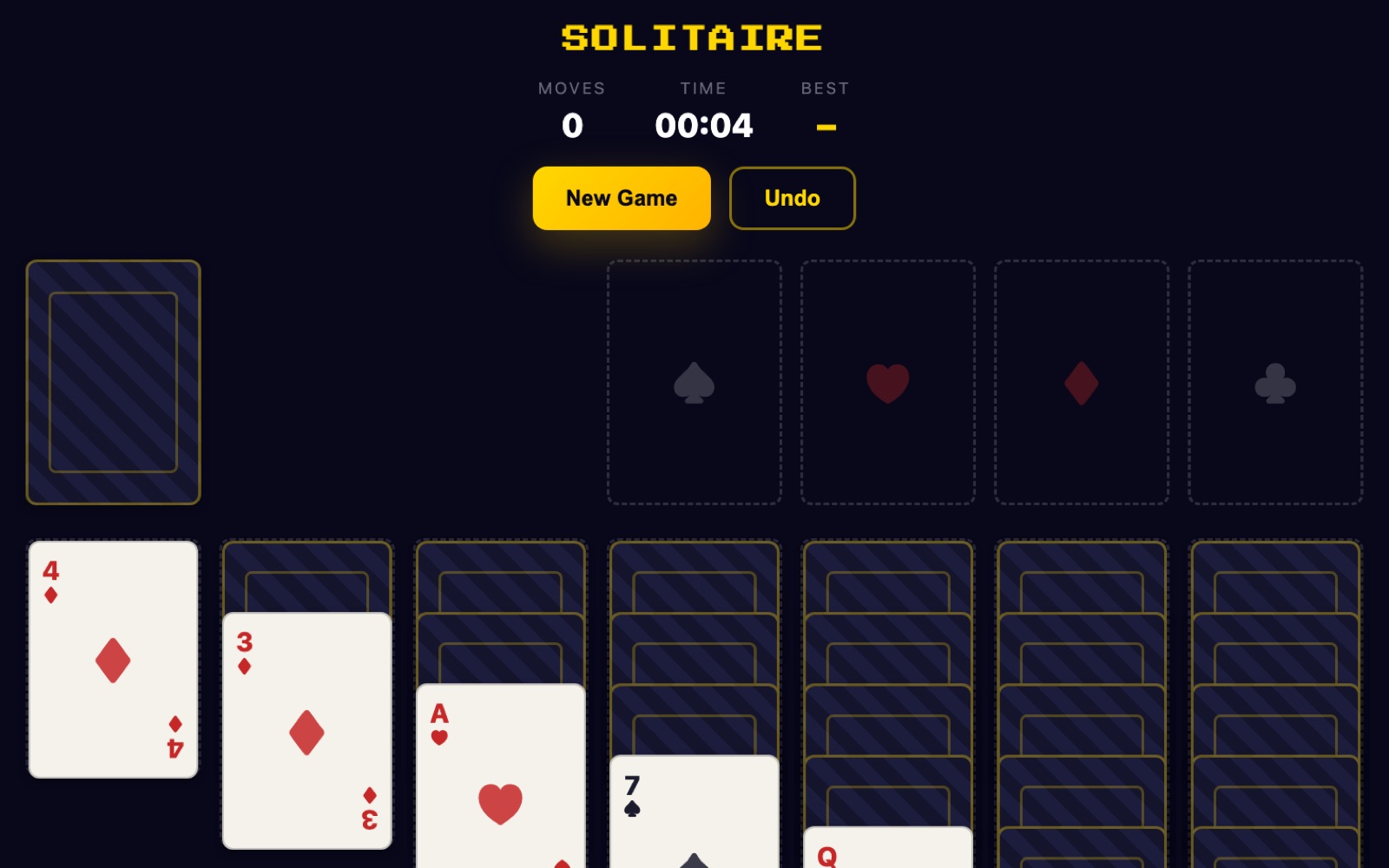
What is Klondike Solitaire?
Klondike is the version of Solitaire almost everyone means when they say “Solitaire” — the one bundled with desktop computers for thirty years. One shuffled 52-card deck is dealt into seven tableau columns of increasing size: one card in the first column, two in the second, and so on up to seven in the last. Only the bottom-most card of each column is turned face-up; the other twenty-one sit face-down and have to be earned. The twenty-four cards left over become the stock, which you turn over one at a time into the waste pile beside it.
Above the columns sit four foundation piles, one per suit — spades, hearts, diamonds and clubs, in that order on this board. Each starts empty (shown as a faded suit symbol) and has to be built upward in order from the Ace to the King. Move all 52 cards onto the foundations and you've won.
Everything in between is a sorting problem. The tableau is your workspace: columns build downward in alternating colours, so a red 7 accepts a black 6, which accepts a red 5. Every card you place there is a card you're not sending to a foundation yet, and every face-down card you uncover is new information. The tension between those two — digging deeper versus banking cards — is the whole game.
This version is human-played only. There's no bot, no recording and no timer pressure: the HUD counts your moves and your elapsed time, and neither one ever runs out.
How to play
- Deal. Press “Deal” on the opening card to shuffle and lay out a fresh game. “New Game” above the board does the same thing at any point, and pressing N is the keyboard shortcut.
- Tap or click a card to select it. There is no drag-and-drop here — selection is two taps, which works identically with a mouse and a thumb. The selected card lifts slightly and gets a gold outline. If you select a card in the middle of a column, every face-up card stacked on top of it is selected too, because valid sequences always travel together.
- Tap the destination pile. While something is selected, every pile that would legally accept it is ringed in gold, so you can see your options before committing. Tap a highlighted column or foundation and the move happens. Tap the same pile you selected from to deselect; tap an illegal pile and nothing moves — the game simply switches your selection to that card instead if it's selectable.
- Build the tableau down in alternating colours. A card only lands on a tableau card exactly one rank higher and of the opposite colour. An empty column is special: only a King (or a run starting with a King) may be placed there.
- Build the foundations up by suit. A foundation accepts a single card at a time, starting with the Ace and continuing 2, 3, 4 … up to the King of that same suit. You can't send a multi-card run to a foundation.
- Double-click to send a card straight home. Double-clicking the top card of a column, or the face-up card in the waste, routes it to its own foundation automatically if the move is legal. It's the fastest way to clear the board once the Aces are out.
- Turn the stock one card at a time. Tap the face-down stock pile to flip its next card to the waste; only the top waste card can be played. When the stock runs out it shows a “↻” symbol — tap it once more and the whole waste pile flips back over to become a fresh stock. That recycle is free: it doesn't add to your move count, while each individual draw does.
- Uncovered cards flip themselves. Whenever you empty the last face-up card off a column, the face-down card beneath it turns over automatically. You never have to click to reveal.
- Undo whatever you like. The “Undo” button (or the U key) steps back through a full history of up to 300 board states — moves, draws and stock recycles included. Klondike rewards experimentation, and undo is what makes experimenting cheap.
Strategy that wins more games
Play Aces and Deuces up immediately
An Ace can never be built on in the tableau — nothing is lower than it — so it does nothing but occupy space and block whatever sits beneath it. The same is nearly always true of a 2 once its Ace is up. Send them home the moment you see them.
Prefer the move that exposes a face-down card
Twenty-one of the 52 cards start hidden, and every one of them is a card you can't plan around. When two moves look equally good, take the one that flips something over — you gain both a playable card and information. Given a choice, dig into the longest face-down stack first: those cards are the hardest to reach later, and the columns on the right have the most buried under them.
Empty a column only when you have a King ready
An empty column is the most valuable real estate on the board, because it's the only place you can park a King and start a whole new descending run. But it's also the only slot a King can fill. Clearing a column with no King available — not in the tableau, not in the waste — leaves you holding a space you can't use, and you may have spent good cards emptying it.
Think before you empty the waste
Because this is draw-one, the waste pile is an ordered queue you cycle through repeatedly. Playing waste cards greedily changes what sits on top the next time round, and a card you leave behind now is one you'll meet again. Before you take a waste card just because you can, check whether it does actual work: does it flip something, or unblock a column? If not, leaving it lets you reach the card underneath sooner.
Don't rush cards to the foundation you may still need
This is the mistake that loses winnable deals. Once a black 6 is on its foundation, it can no longer host the red 5 you'll uncover two moves later. A rough guideline: keep a card in the tableau if a card two ranks below it, in either opposite colour, is still unplaced. Aces and 2s are exempt. Note that this board does let you pull a card back off a foundation onto a legal tableau spot, and Undo covers you as well — but it's cheaper to just not send it.
Look at the whole board before your first move
The opening deal is fully visible for seven cards. Scan for Aces, for a King that could take a column, and for pairs that already fit together, then plan two or three moves ahead rather than taking the first legal move you spot.
Is every deal winnable?
No — and any site that claims otherwise is guessing. This game deals a genuinely random shuffle, with no filtering for solvable layouts, which means a small share of deals cannot be won no matter how well you play. The exact figure depends on the rules, but for draw-one Klondike the overwhelming majority of deals are theoretically solvable by a perfect player; realistic human win rates land far lower, typically somewhere between a third and two thirds depending on skill and patience.
Draw-one, as played here, is considerably more forgiving than draw-three. With three cards turned at a time, only every third card in the stock is reachable on a given pass, which locks away a big chunk of the deck. Turning one card at a time means every card in the stock is available to you on every pass — so if you're stuck, the problem is far more often the order of your tableau moves than the deal itself. Undo a few steps and try a different branch before starting over.
About your best score: “Best” in the HUD is the fewest moves in which you've completed a game — lower is better, and it only updates when you actually win. It's saved locally in your browser under a single small key, so it survives between visits on the same device with no account needed. See our Privacy Policy for details.
Frequently asked questions
Can I drag cards instead of tapping?
No — this version is tap-to-select, tap-to-place by design. It behaves identically with a mouse and on a touchscreen, and it avoids the mis-drops that drag-and-drop causes on small phone screens.
How do I move several cards at once?
Click the lowest card of the run you want to move rather than the top one. The card you click and every face-up card above it are selected together, and they move as a block if the destination accepts the bottom card of that run.
Is this draw-one or draw-three?
Draw-one. Each tap of the stock turns exactly one card into the waste, and when the stock empties you can recycle the waste and go through it again as often as you need.
Can I take a card back off a foundation?
Yes. Select the top foundation card and tap a tableau column that legally accepts it. You can also just press Undo, which walks back through your recent moves one at a time.
Does the timer affect my score?
No. Time is displayed for interest only; the saved best is based purely on move count, so playing slowly and thinking costs you nothing.
Do I need to install anything or sign up?
No. Solitaire runs entirely in your browser on desktop or mobile — no download, no plugin, no account, and it's free to play.