Sky Hop
A one-button endless flyer. Gravity pulls your gold hopper down without pause; every click, tap or press of Space kicks it back up. Thread the gaps between the crystal pillars for as long as your rhythm holds.
▶ Play Sky Hop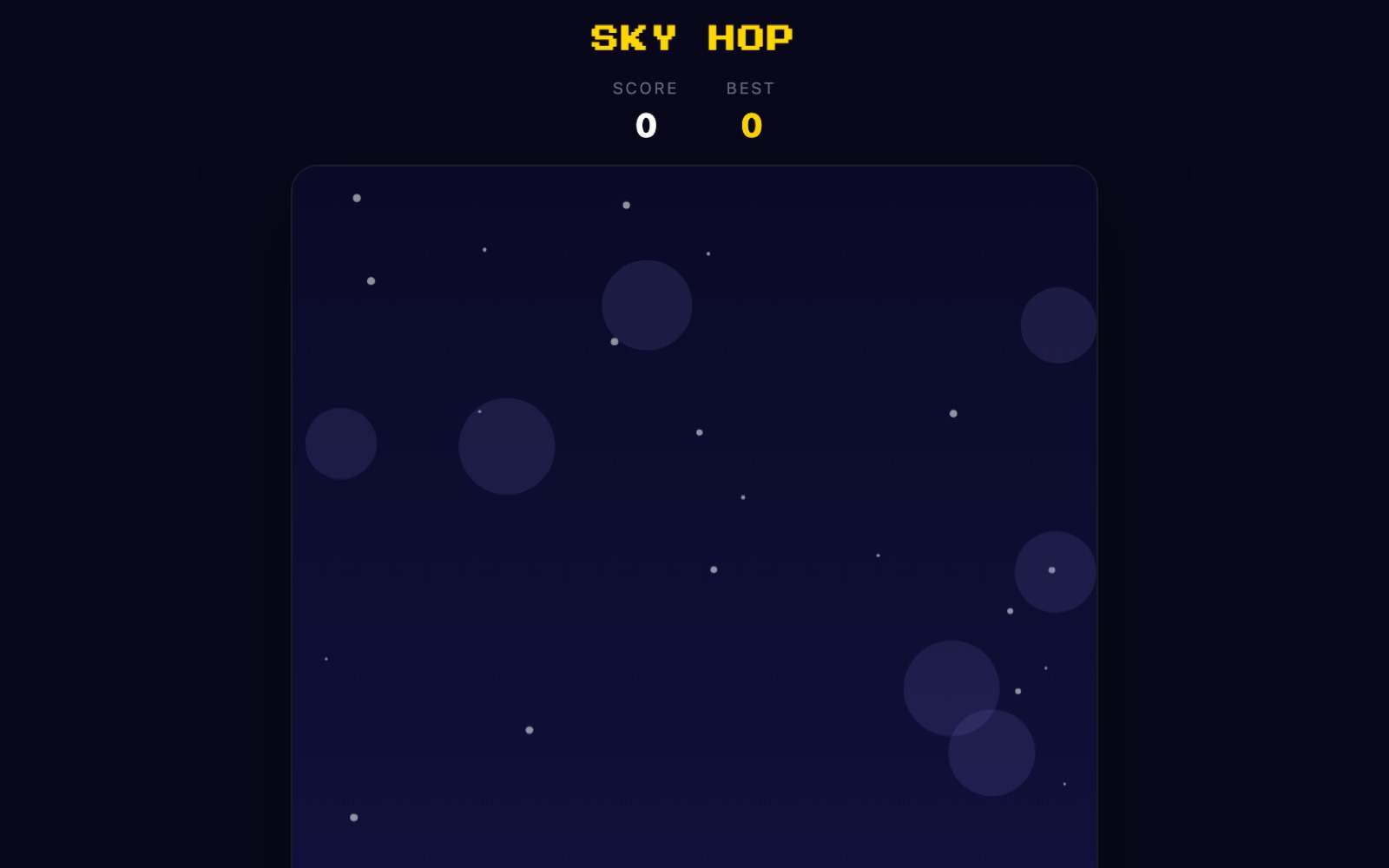
What is Sky Hop?
Sky Hop is an original twittyn game with exactly one verb: flap. There is no steering, no brake and no second button. The hopper sits at a fixed point roughly 30% of the way across the play area and never moves horizontally — the world scrolls past it instead. All you control is height, and you control it indirectly: each input replaces your current vertical velocity with a fixed upward impulse, after which constant gravity immediately starts eating into it again.
That single rule is what makes the game readable. Gravity accelerates the hopper downward at a steady rate and caps out at a terminal falling speed, so a long dive is fast but never runaway-fast. One flap lifts you roughly sixty units in the virtual play space before the climb stalls and the fall resumes, which is a bit more than two hopper-heights. Everything else — where the pillars sit, how fast they arrive, how wide the gap is — follows from your score.
The game runs on a fixed virtual field of 360×480 units that is scaled to fit whatever screen you're on, so a phone and a desktop monitor get identical physics and identical difficulty. There's no bot, no auto-play and no recording here: unlike the reveal-style games on twittyn that are built for a camera, Sky Hop is purely human-controlled.
How to play
- Start the run. Press the “Start” button, or hit Space or Arrow Up. The overlay sits on top of the canvas and swallows the pointer event that dismisses it, so the click that starts the game never doubles as your first flap — you begin in a level glide.
- Flap with one input. Click, tap anywhere on the play area, or press Space or Arrow Up. All four do exactly the same thing: set your upward velocity to a fixed value and emit a small puff of thruster particles behind the craft.
- Read the tilt. The hopper's angle is driven directly by its vertical velocity, clamped to a modest nose-up and a steeper nose-down. It is a live readout, not decoration — if the nose has already dropped past level, you are accelerating downward and a flap is overdue.
- Thread the pillar pairs. Pillars arrive in pairs sharing one gap, with the gap placed at a random height inside a fixed vertical band. The band keeps every gap clear of the very top of the screen and of the ground strip, so no pair is ever unreachable.
- Score by passing, not by touching. You get exactly +1 the moment a pair's trailing edge clears the hopper's fixed x position. There are no bonuses, no combos and no partial credit.
- Avoid all three kinds of contact. Touching a pillar ends the run instantly, and so does hitting the ground strip at the bottom or the ceiling at the very top. The ceiling is a real wall, not a soft bumper — flying too high kills you just as fast as falling.
- Play again. Press “Play Again”, or just tap Space or Arrow Up from the game-over screen. Everything resets: score to zero, gap back to its widest, speed back to its slowest, and a half-spacing head start before the first pair appears.
Tips for a higher score
- Tap in a steady rhythm instead of reacting. Because a flap overwrites your velocity rather than adding to it, a metronome-like tap pattern produces a predictable sawtooth altitude that you can aim with. Panic-flapping produces a stack of near-identical impulses and shoots you straight into the ceiling, which is a loss just like a pillar.
- Aim for the middle of each gap, not the edge you can see. The gap starts at 176 units against a 24-unit craft, so the centre line is genuinely generous. Steering for the middle absorbs one mistimed flap; skimming the lower pillar leaves you nothing when gravity gets a beat ahead of you.
- Start the climb early. The impulse takes roughly three tenths of a second to cancel gravity and reach the top of its arc, and the pillar keeps travelling toward you the whole time. If you wait until the gap is level with your nose you have already fallen below it. Commit to the height while the pillar is still a body-length away.
- Resist double-tapping near the ceiling. There is no upward margin at all — the top of the play field ends the run on contact. When you're already in the upper third, let gravity do the work and put your next flap in later than instinct wants.
- Use the fall on descending gaps. Terminal velocity is capped, so a long, uninterrupted dive is stable and controllable. When the next gap sits low, stop flapping entirely and take one clean fall rather than several small corrections.
- Watch the ground ticks, not the stars. The background scrolls in three layers at different rates: distant stars drift slowest, the translucent rocks move at a middling pace, and the tick marks on the ground strip run at full course speed. The ground is your honest speedometer — when the ticks visibly quicken, tighten your timing.
How the difficulty ramps up
Two values scale with your score, and both are clamped so the game never becomes unwinnable.
The gap narrows
The vertical opening between each pillar pair starts at 176 units and shrinks by 1.5 units for every point you score. It stops at a floor of 122 units, which you reach at a score of 36. Beyond that, every gap you ever see is exactly the same size — a little over five times the hopper's height. Nothing gets tighter no matter how far you go.
The course speeds up
Scroll speed begins at 148 units per second and gains 2.1 per point, capping at 248 — about 68% faster than the start, reached at a score of 48. Pillar pairs are spawned by distance travelled rather than by a timer, always 232 units apart in world space, so faster scrolling means the pairs arrive sooner but never bunch up unevenly. In practice the interval between pairs tightens from roughly 1.6 seconds at the start to about 0.9 seconds once you're past the speed cap.
The upshot: everything past a score of 48 is a plateau. The gap is fixed, the speed is fixed, the spacing is fixed, and the only variable left is where each gap happens to be placed. A long run is a test of consistency, not of surviving an ever-steepening curve.
Good to know: Your best score is saved locally in your browser under a single key (twittyn_skyhop_best) and read back the moment the page loads — no login, no server, nothing else about your session stored. Clearing your site data or switching device resets it. See our Privacy Policy for details.
Frequently asked questions
Do I need to install anything?
No. Sky Hop runs entirely in your browser on desktop or mobile. No plugins, no downloads, no account.
What are the controls?
One input, four ways to give it: click, tap the play area, press Space, or press Arrow Up. From the start or game-over screen, Space and Arrow Up also begin the next run.
Can I hit the top of the screen?
Yes, and it ends the run. The ceiling is treated exactly like the ground and the pillars — contact is fatal. This is the single most common way new players lose points they'd otherwise have kept.
Does it keep getting harder forever?
No. The gap stops narrowing at a score of 36 and the scroll speed stops rising at 48. After that the difficulty is completely flat and only the random gap placement changes from pair to pair.
I switched tabs and came back — why didn't I die?
The frame loop clamps any single time step to 250 milliseconds, so a browser that pauses animation on a hidden tab can't hand the physics a huge delta and teleport your hopper into a pillar. You'll resume close to where you left off rather than being punished for a background tab.
Is my best score saved, and is the game free?
Your best is stored in your browser's local storage and persists between visits on the same device. The game is completely free, with no time limits, ads inside the play area, or paywalls.