Minesweeper
The classic logic puzzle, rebuilt for the browser. Clear a grid of hidden tiles without detonating a mine, use the numbers to deduce what's safe, and race the clock for a new best time.
▶ Play Minesweeper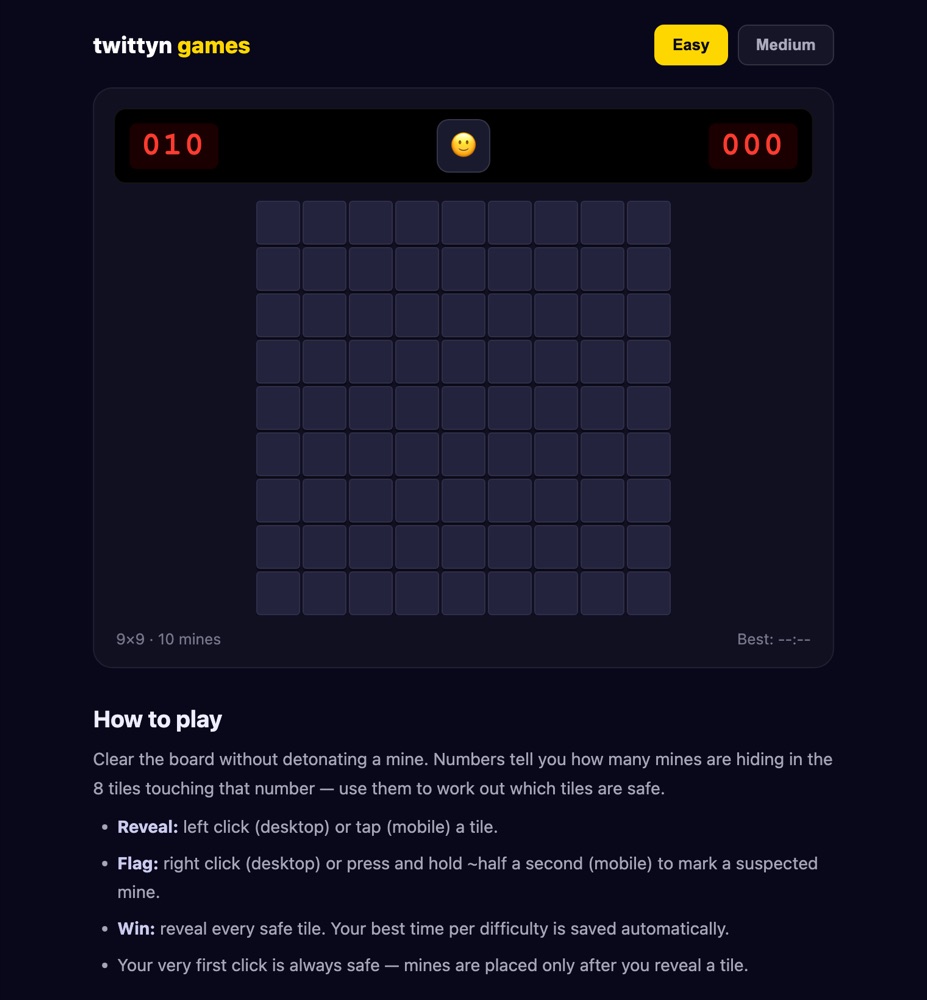
What you're actually playing
Minesweeper is a deduction puzzle wearing the costume of a game of chance: underneath a grid of blank tiles sits a fixed number of mines, and every tile you clear reveals a single digit — the count of mines touching that tile among its up to eight neighbours. Nothing about a board is truly hidden information; in principle every position is solvable from the numbers alone, right up until you run out of certain moves and have to guess. twittyn's build runs the two classic Minesweeper sizes, Easy at 9×9 with 10 mines and Medium at 16×16 with 40 mines, and keeps the interface close to the original: dark tiles, a live mine counter, a running timer, and a face button that reacts to what's happening on the board.
The mechanics behind the board
Two rules do most of the work in making Minesweeper fair rather than random. First, mines aren't on the board when a level loads — they're placed the instant you make your first click, and the game deliberately keeps mines out of the clicked tile and all of its neighbours, so the opening move always lands on open ground with at least a few numbers to read. Second, revealing a tile with zero adjacent mines triggers a flood-fill: the game automatically opens every connected zero-tile and stops at the first ring of numbered tiles around them, which is why a lucky early click can clear a third of an Easy board in one move.
Flags are a placeholder for "I'm sure this is a mine," not a way to win directly. Right click on desktop, or press and hold for about half a second on mobile (a short vibration confirms it), toggles a flag on a hidden tile and blocks it from being revealed by accident. The mine counter at the top simply subtracts your flag count from the total mine count, so it tells you how many mines you haven't accounted for yet, not how many tiles are left to clear. You win the moment every non-mine tile is revealed — you don't have to flag a single mine to clear the board, though the game flags every remaining one for you automatically once you do. Hit a mine instead, and the whole board is revealed at once: the mine you triggered lights up red, and any flag you'd placed on a tile that wasn't a mine gets marked wrong.
Reading the numbers like a solver
Each number uses its own colour by convention — 1 is blue, 2 green, 3 red and so on up through 8 — mostly so your eyes can scan a crowded board and pick out the relevant numbers fast. The actual solving comes down to two techniques you'll lean on constantly. First: once a numbered tile's mine count is fully matched by flags touching it, every other hidden neighbour of that tile is guaranteed safe, so reveal them all without hesitation. Second, and the one that separates a fast clear from slow guessing: if a "1" has only one hidden neighbour left, that neighbour is a mine with certainty — flag it instead of working around it. When two numbers share an overlapping group of hidden tiles, subtracting one count from the other often pins down a mine or a safe tile that neither number gives up on its own; that's the logic behind classic shapes like the "1-2-1" edge pattern, where the outer 1s force both mines to sit directly under the 2's flanks. When you truly run out of forced moves, the safest guess is usually a tile touching the lowest number left on the board, since low numbers mean a smaller share of their hidden neighbours can possibly be mines.
Good to know: Minesweeper runs entirely in your browser — nothing you do on the board is sent anywhere, and your best time per difficulty is stored locally on your own device. See our Privacy Policy for the details.
Frequently asked questions
Can I lose on my very first click?
No. Mines aren't placed until after that click, and the game keeps them away from both the tile you clicked and its immediate neighbours, so the opening move always gives you something to read.
Do I have to flag every mine to win?
No. You win as soon as every safe tile is revealed — flagging is just a memory aid for you, not a win condition. Any mines you didn't flag get marked automatically the moment you clear the board.
How do I flag a tile on mobile?
Press and hold for about half a second; a short vibration confirms the flag is placed. Do the same again to remove it.
What's the difference between Easy and Medium?
Easy is a 9×9 grid with 10 mines, a size you can usually read at a glance. Medium jumps to 16×16 with 40 mines, a denser board with proportionally more edge cases and the occasional forced guess.
Is my best time saved?
Yes, your fastest clear for each difficulty is saved locally in your browser and shown next to the timer, so you've always got a time to beat.