Paddle Duel
Our own two-paddle rally game, in the tradition of classic bat-and-ball arcade machines. You take the gold paddle on the left, the CPU takes the blue one on the right, and the first side to 11 points takes the match.
▶ Play Paddle Duel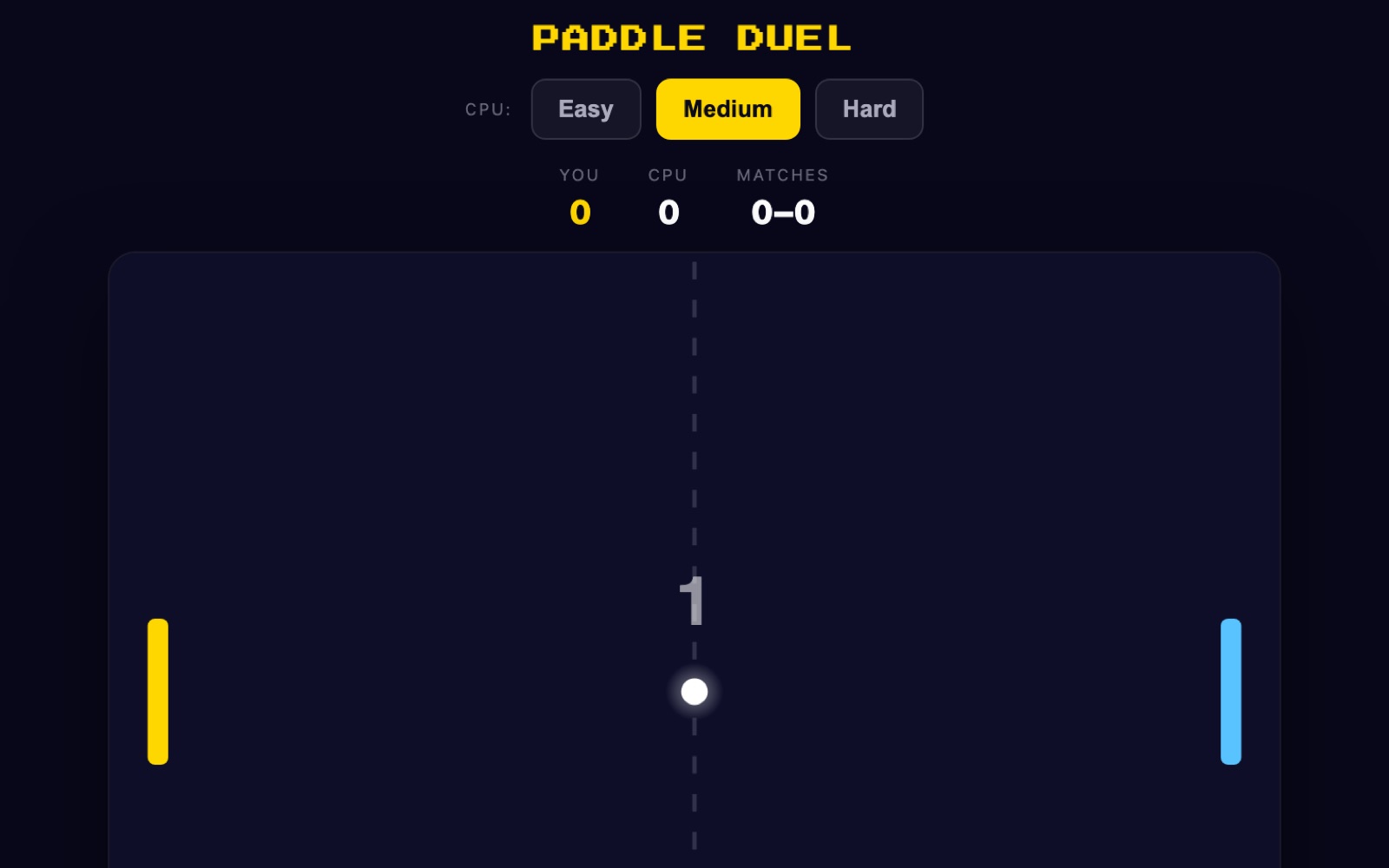
What is Paddle Duel?
Paddle Duel is a browser game built in-house at twittyn. The court is a 4:3 rectangle — 800 by 600 units internally, scaled to whatever size your screen allows — with a dashed centre line, one paddle on each side and a single ball. The paddles are tall and thin (100 units of the court's 600-unit height, so exactly one sixth of the court), and each sits 26 units in from its own edge, which leaves a narrow gutter behind them. Get the ball into the opponent's gutter and past the wall behind it, and you win the point.
There is no bot mode and nothing is recorded here. Unlike the reveal-style titles on twittyn, which exist to be played by an AI in front of a camera, Paddle Duel is purely for a human at the controls. The whole match happens client-side: no account, no server round trip, no loading screen.
What gives it depth is that the ball is never returned the same way twice. The angle of your return is decided by where on the paddle the ball lands, and the ball gets 5 % faster on every single paddle contact until the point ends. A long rally is genuinely harder to survive than a short one, and both players feel that pressure at the same time.
How to play
- Pick your CPU difficulty first. Easy, Medium or Hard sit above the court; Medium is selected by default. You can switch tiers between matches — the change takes effect from the next serve onwards.
- Start the match. Press the Start button, or hit Space or Enter. Scores reset to 0–0, both paddles snap back to the vertical centre, and the first serve direction is chosen at random.
- Move your paddle. Four input methods all work at once: move the mouse anywhere over the court, drag with a finger anywhere on the court (you don't have to touch the paddle itself), or hold the Arrow Up / Arrow Down keys or W and S. Mouse and touch map your pointer's vertical position straight onto the paddle, so they are instant; the keyboard moves the paddle at a fixed 620 units per second, which is deliberately quick but not teleport-fast.
- Wait out the serve countdown. After every point there is a one-second pause with a countdown number above the centre of the court. The ball then launches from the middle at the base speed with a random angle of up to 25°, always aimed at whichever side just conceded — so if you scored, the next ball comes at the CPU.
- Return the ball. A hit reverses the ball's horizontal direction and recalculates its angle from the contact point. Miss, and the ball has to travel fully past the back wall before the point is awarded, so a near-miss really is a miss.
- Reach 11 points. The match ends the instant either side hits 11. The overlay shows the final score and a Play Again button; Space or Enter restarts too.
Master the bounce angle
This is the single mechanic worth learning, and it is completely deterministic — there is no randomness in a return at all.
When the ball touches a paddle, the game measures how far the ball's centre is from the paddle's centre and converts that into an angle. Dead centre gives you zero: the ball comes off perfectly flat and horizontal. The extreme top or bottom edge gives you the maximum, 50° from horizontal. Everything in between scales smoothly — halfway up the paddle is roughly 25°, a quarter of the way up is roughly 12°. Hitting above the centre sends the ball upward, below the centre sends it downward.
The practical consequence is that you choose where the ball goes, not luck. A flat centre hit is the fastest route back across the court and gives the CPU the least time to think, but it also arrives right where the CPU is already standing. An edge hit takes longer to cross and often bounces off the top or bottom wall on the way, but it lands far from where the CPU currently is.
Use that to pull the opponent apart. If the CPU returns from high up the court, meet its ball low on your paddle so your return heads back down — it now has to travel the full height of the court to reach it. Do that twice in a row and you have a paddle that is permanently a beat behind. One caution: the game enforces a minimum horizontal component of 35 % of the ball's speed, so even a full-edge hit can never turn into a near-vertical shot that ping-pongs between the walls forever. Steep is possible, stalling is not.
Beating the Hard CPU
The CPU is not psychic, and its three limitations are all exploitable once you know them.
First, it only tracks the ball while the ball is on its own half of the court. The moment the ball crosses the centre line towards you, the CPU stops chasing and drifts back to the vertical centre — at half its normal speed. That drift is your window: it is heading to the middle, so a return aimed at either extreme has the longest possible distance to cover.
Second, its paddle has a hard speed cap: 230 units per second on Easy, 340 on Medium, 470 on Hard. Even the Hard CPU is slower than your keyboard paddle at 620, and far slower than a mouse, which is effectively instantaneous. It cannot cross the whole court in the time a fast, wide return takes to arrive. Alternating high and low returns is therefore the core tactic — each shot is a demand for a full-height sprint it can only just afford.
Third, it aims imperfectly. Each time the ball crosses into its half it rolls a fresh random targeting offset and commits to it for that whole approach: up to 46 units either way on Easy, 24 on Medium, and only 10 on Hard. Against a paddle whose half-height is 50 units, Easy's error is nearly enough to whiff on its own, while Hard's is only ever a nudge off perfect — it will still catch the ball, but often on the paddle's edge rather than its centre, which is exactly when its returns get wild.
Add the rally ramp on top. Every paddle contact multiplies the speed by 1.05 up to a ceiling of 760 units per second, then the whole ramp resets to the base speed on the next serve. Since the CPU's paddle speed never changes but the ball's does, long rallies quietly shift the odds in your favour — especially on Hard, where its small aiming error becomes far more costly at high speed. Don't rush to end a rally with a risky edge shot on the third hit; keep it alive with safe returns, let the ball pick up pace, and place the winner once the speed is high enough that it can no longer recover.
Two more details worth knowing: the ball's movement is calculated in small sub-steps of at most 8 units, so a fast ball can never tunnel straight through a paddle — if you got there, you get the hit. And because the serve always goes to the side that just conceded, losing a point means you receive next, which is a slight disadvantage you should plan for rather than resent.
Good to know: Your lifetime record is kept in the MATCHES readout in the header, shown as wins–losses. It is stored locally in your browser under two small keys and only updates when a match actually reaches 11 points — abandoning a match halfway counts as nothing. Nothing else about your session is saved and no account is involved; see our Privacy Policy for details.
Frequently asked questions
How many points win a match?
Eleven. The match ends the moment either side reaches 11, so a run of points late on can finish things quickly — there is no two-point margin requirement.
Can I play on a phone or tablet?
Yes. Drag anywhere on the court with one finger and your paddle follows your finger's vertical position; you never need to touch the paddle itself. The court keeps its 4:3 shape and scales to fit the screen.
Why did the game pause on its own?
It pauses automatically whenever the browser window loses focus or the tab is hidden, so switching apps mid-rally can't cost you a point. Click Resume, or press Space or Enter, to pick up exactly where you left off.
Does the ball get faster?
Within a rally, yes — 5 % per paddle hit, up to a fixed ceiling. The speed then resets to the base value for the next serve, so every point starts on equal footing no matter how brutal the previous rally was.
What actually changes between Easy, Medium and Hard?
Two numbers: how fast the CPU paddle can move, and how large its random aiming error is. Its logic is identical on all three tiers — it predicts where the ball will arrive, including bounces off the top and bottom walls, then moves toward that point as fast as its tier allows.
Is it free, and do I need to install anything?
Completely free, with no downloads, plugins or account. It runs in any modern browser on desktop or mobile.